1. Project Overview
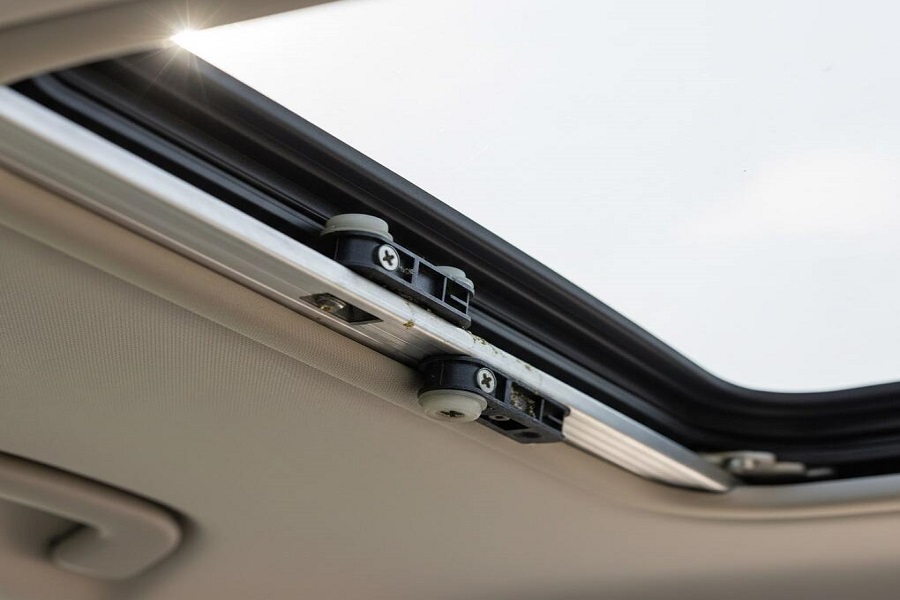
Component: Sunroof Development Curve Guide Rail
Material: Aluminum Extrusion
Process: Press Tool Stamping (5-stage progression)
Customer Requirement: Lightweight and dimensionally accurate guide rail suitable for smooth sunroof operation.
2. Background
Upon receiving the RFQ (Request for Quotation) for the sunroof guide rail, our engineering team initiated the product and process development activities. The component was identified as a precision-critical aluminum guide rail with complex features such as trimming, slotting, embossing, and notching.
The project objective was to develop and manufacture a stamping tool set capable of producing consistent, dimensionally accurate parts for mass production.
3. Development Process
Stage Categorization
To ensure systematic development, the manufacturing process was divided into five stages:
| Stage | Operation | Description |
| 1 | Trimming | Initial contour trimming of the extrusion profile |
| 2 | Slotting | Creation of slots for the sunroof mechanism fitment |
| 3 | Embossing | Forming of stiffening features for rigidity |
| 4 | Notching | Removal of corner material to reduce weight and enable assembly clearance |
| 5 | Final Trimming & Piercing | Achieving final geometry and mounting features |
Each stage was carefully designed in Press Tool Design, ensuring balanced load distribution, proper alignment, and minimal deformation of the aluminum profile.
4. Challenges Faced
1. Extrusion Profile Entry Issue
During the initial manufacturing phase, the extrusion profile failed to enter the stamping tool correctly.
- Cause: The actual extrusion cross-section deviated from the CAD model due to dimensional variations in the aluminum extrusion process.
- Action Taken:
- The extrusion supplier was engaged for correction.
- Three iterations of extrusion correction were carried out to achieve the required tolerance band.
- Result: The extrusion finally matched the stamping tool entry profile, enabling smooth operation.
2. Stamping Tool Deviations
After the first stamping trials, several deviations were observed:
- Slot position deviation
- Trimming end misalignment
- Emboss height variation
Inspection:
A CMM (Coordinate Measuring Machine) was used to measure the part at critical dimensions and identify the deviation map.
Corrective Actions:
- Tool shimming and localized re-machining were performed.
- Emboss die height was recalibrated.
- Slots and trimming punches were realigned based on CMM data.
Outcome:
Post-correction, the dimensional deviations were brought within tolerance limits as per the drawing specifications.
5. Results and Mass Production Readiness
| Parameter | Initial | After Correction |
| Extrusion Entry Fit | Misaligned | Smooth entry |
| Slot Position | ±0.8 mm deviation | ±0.1 mm (within spec) |
| Emboss Height | Inconsistent | Uniform across rail |
| Trim Edge | Rough, off profile | Accurate contour |
After the successful validation of the tool, pilot production trials were conducted. The produced parts met all customer quality and dimensional requirements.
6. Key Learnings
- Early validation of extrusion profiles is critical before tool manufacturing.
- Iterative tool tuning with CMM inspection ensures precision in aluminum stamping.
- Aluminum material requires careful handling due to its softness and tendency to deform under pressure.
- Close collaboration between design, manufacturing, and supplier teams accelerates problem resolution.
7. Conclusion
The Sunroof Guide Rail project demonstrated a complete product realization cycle—from RFQ to mass production—highlighting the importance of cross-functional coordination and iterative improvement.
Despite challenges in extrusion accuracy and stamping tool calibration, the team successfully achieved a robust, repeatable process ready for full-scale production, ensuring high-quality output and customer satisfaction.